Mathews aims to give us an understanding of the institutional structures that quietly shape our lives, and also explores how their designs and technologies can be détourned into objects of calm, quietude and play.
— Michael Newall
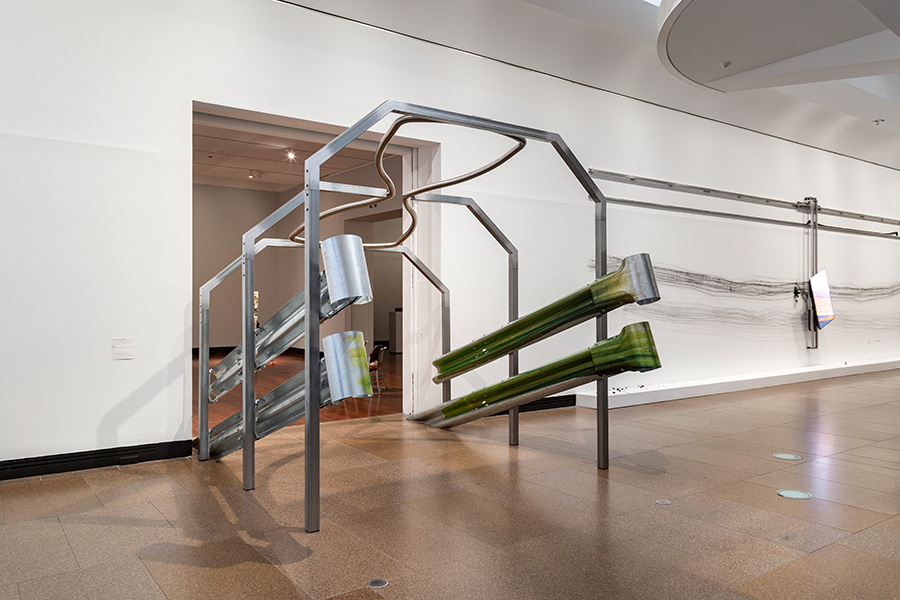
Image: Jennifer Mathews, Ramp, 2026. Installation view, 2026 Adelaide Biennial of Australian Art: Yield Strength, Art Gallery of South Australia (AGSA), Tarntanya/Adelaide. Photograph by Saul Steed. Courtesy the artist.
JENNIFER MATHEWS (SA)
Jennifer Mathews is a sculptor and installation artist who repurposes industrial and architectural design in powerful and provocative ways. Her recent work adapts designs used in the industrial farming of livestock, drawing out responses that encourage the viewer to reflect on complex expresses of embodiment in institutional spaces. This is illustrated vividly in the sculptural centrepiece of her installation UNIT (2024, LAILA, Sydney), which comprises three hay feeders. The feeders are simple cylinders with arched loops fitted to their rims to ensure animals’ access to their contents is controlled. Like much of her work, the feeders are made of steel with a dully anaesthetic, cleanly institutional finish. Mathews has designed these feeders not to animal proportions, but to those of humans. One is sized for a child, a second for an adult, and a third (slightly smaller) for an aged person. In the first instance, they encourage the viewer to imagine themselves in the place of livestock. Other cues, such as the pointedly bland finish of the sculptures, encourage us to dwell on how the institutional architecture and design shapes our bodily awareness. As Mathews observes, “I’m more interested in borrowing infrastructures designed to organise, measure and direct bodies, [and] then rescaling or repositioning them so we experience their logic in relation to human bodies and institutional spaces.” Other elements of the installation develop these themes. Obsidian-black hourglass-shaped forms are set into wall-mounted steel frameworks of geometric design, and vinyl images of a huge stick and carrot are applied directly to the gallery walls. Comparable approaches are used in Coercion Cradle (2023, Al Fresco, Kamberri/Canberra), a site-specific work in the ruins of an observatory on Mt Stromlo. This installation borrows design components from a cattle crush – a mechanism used to immobilise cattle for branding and medical treatment – and adapts them into a gate–aperture through which viewers uncomfortably pass.
Mathews’ strategies are most fully realised in Ramp and Yard (both 2026, Adelaide Biennial, Art Gallery of SA). Yard is modelled on a blind cattle run, a narrow, curved, high-walled corridor designed to calm and control the movement of the animals. Mathews’ version bifurcates into two curved sections, and, like her other works, is modelled to human proportions. Art audiences will recognise some of the effects from the techniques of Minimalism and Post-Minimalism, which place the viewer within structures that require them to physically negotiate them, drawing forth an awareness of the viewer’s embodiment. In placing the viewer in the position of livestock being ‘processed’, I can’t help but think of Roald Dahl’s disturbing short story ‘Pig’, in which the protagonist finds a guided tour of an abattoir to be not quite what was advertised.[1] But Mathews points out that the agricultural tools that she draws from are also designed to calm, monitor and provide safe medical treatment. Their institutional aesthetic puts the viewer in mind of the physical institutions in which we spend so much time, such as schools, hospitals and offices. The symbols embedded in them again encourage the viewer’s thoughts towards broader existential themes. Ramp – modelled on a cattle loading ramp – has an hourglass shape incorporated into its design, and Yard has similarly incorporated into its framework arrows corresponding to one-way movement. In these ways, as Mathews puts it, “the agricultural references … open onto the wider ideas in the work rather than determine its final meaning”.
For Mathews, there are also pleasures to be found in the way movement and experience are shaped by these forms and symbols. The tall, narrow walls of Yard draw on features of blind runs designed to calm animals – and they work just as well on people. The tall walls reduce visual stimuli, and their curved corridors do the same, by allowing one to see only a short way ahead. For those passing through amid the visual stimulation of the Adelaide Biennial, it created an immersive, calming moment. Another pleasurable note is found in the guard rails of Ramp, which are playfully decorated with prints of giant celery sticks.
Mathews expands on the connections between animals and humans by citing ideas of left-wing commentator Aaron Bastani.[2] Much as animal labour became redundant in the twentieth century, replaced by motorised vehicles and engines, so a similar redundancy at the hands of technology is affecting human workers – and with the development of AI, much more human labour may yet become outsourced. Bastani sees these links as part of a broad historical trajectory that society risks overlooking. But, as Mathews puts it, “[m]y interest … [is] in the shifting relationships between bodies, labour, technology and systems of organisation” that these changes reveal. It is the day-to-day actualities of these changes that are revealed and distilled in Mathews’ work. Mathews thus aims to give us an understanding of the institutional structures that quietly shape our lives, and also explores how their designs and technologies can be détourned into objects of calm, quietude and play.
[1] Roald Dahl, ‘Pig’, in Roald Dahl, Kiss Kiss, New York: Alfred A. Knopff, 1960.
[2] Aaron Bastani, Fully Automated Luxury Communism: A Manifesto, London: Verso, 2019.
Essay written by Michael Newall.
Michael Newall is a writer, academic and Co-Director of The Little Machine: Space for Contemporary Art in Tarntanya/Adelaide, South Australia.
2027 Samstag International Visual Art Scholarship
2016 First Class Honours in Fine Art, Victorian College of the Arts
2015 Bachelor of Visual Arts, University of South Australia
Artist's website: https://jenmathews.net/