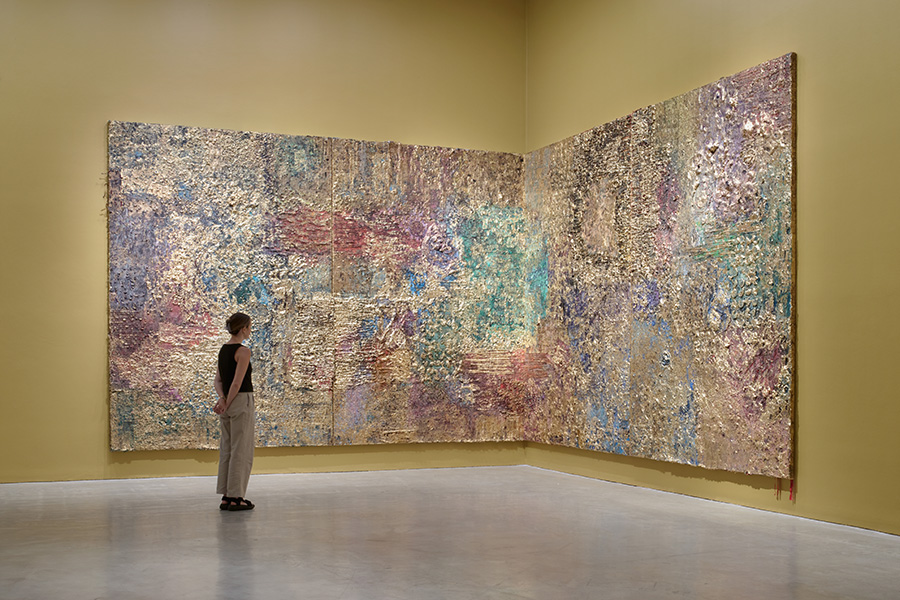
Kain’s materials are associated with ritual, meaning, manual labour and the body within the Indian caste system. These are, she observes, “materials that I have obsessed over, tested for many years, and that affect the body when we stand before them.”
— Michael Newall
Image: Kirtika Kain, The illusion of your history, 2023, installation view, 24th Biennale of Sydney, Ten Thousand Suns, 2023, Museum of Contemporary Art Australia (MCA). Photograph by Hamish McIntosh. Courtesy the artist.
KIRTIKA KAIN (NSW)
Kirtika Kain’s works foreground their materials and techniques, and so, in addressing her practice, it makes sense to say something about these first. Kain uses experimental processes to make materially rich surfaces that hang, stand, drape and lie in wall-based, sculptural and installation formats. These surfaces combine materials both rich and modest, including gold, copper, pigments, turmeric, hessian, hair, wax, plastic, seeds and tar, among many other things. Her techniques encompass and extend methods associated with painting and printmaking (the discipline in which she originally trained), and include processes associated with manual labour, such as scrubbing and peeling, heating and melting, adhering, pouring and layering. The resultant works can appear at once corroded, congealed and agglomerated, mixing and interleaving the lustre of gold and bright pigments with the dense, dark muck of life. Kain’s works vary in both scale and effect, from the intimate to the operatic. At the formal, material and expressive level, she wields her techniques and media with an assurance and impact that can match the exemplary works of colour field painting, tachism, and arte povera.
A key to understanding Kain’s work is her heritage. Her materials are associated with ritual, meaning, manual labour and the body within the Indian caste system. These are, she observes, “materials that I have obsessed over, tested for many years, and that affect the body when we stand before them”. Some – such as gold – are used because of their connection with value within that system. Others are drawn from Kain’s own Dalit heritage. ‘Dalit’ means ‘broken’ or ‘scattered’ in Sanskrit, and refers to the communities on the lowest rung of the caste system. The appropriateness of the term is contested, and, for Kain, ‘Ambedkarite’ better indicates her community and its ethos. Ambedkarism, named for social reformer Dr B. R. Ambedkar, is a Buddhist movement that emerged from India’s lower, ‘scheduled’ castes, rejecting the caste in favour of humanistic principles.
Perhaps the most profound effects in Kain’s work come from the distinctive way in which she combines materials. Kain observes that her materials are placed in opposition in Indian society, and that those attached, for instance, to conceptions of “pure and impure” in that context can become “equal in the studio”, a place that “contains and suspends” them. For Kain, the studio is thus a site in which oppositions are dissolved, and where these materials can be brought together through experiment, intuition and play. As Kain notes, this “freedom to play … hasn’t always been there.”
Some of Kain’s works shine with gold leaf and coloured pigment, such as the large multi-panel piece, The Illusion of Your History (2023). This radiates colour and light, but intermingled with these indicators of caste and culture is a wealth of prosaic and even abject matter, including leather, tar, hair and cow dung. Other works explore the beauty that can emerge from ordinary materials on their own. To take one example, Chronicles (2025) comprises a series of hanging copper panels, covered with tar-dipped cotton strips. Bathed in acid, the panels are eaten away to nothing in some places, while in others the oxidation has produced contrasting red-orange and blue-green areas of patination. The resinous strips resist the corrosive action of the acid, looking like dark, oily stiches or scarification, and loosely holding together the colourful remnants of corroded metal.
In contrast to these vividly coloured works, Midnight (2025) is a vast, black, hanging fabric (presented as a wall-piece at the Samstag Museum of Art in the 2026 Adelaide Biennial). It, too, is the product of a complex process. The work began with a silicon mould of the textured surface of a painted canvas. The exhibited piece is the result of filling the mould with tar, gold leaf and blue acrylic paint, along with the hessian that became its support. Midnight is substantial; made in three different parts, the whole weighs around 150kg. At close quarters, its weightiness is somewhat belied by the the interplay between the density of the tar and the visibly open weave of the hessian. But from a distance, its draped folds glimmer darkly, the visual equivalent of a requiem. With Kain’s other works, this contributes to her larger project of imaginatively reconstructing and synthesising opposed elements in Indian culture and society, to powerful aesthetic and critical ends.
Essay written by Michael Newall.
Michael Newall is a writer, academic and Co-Director of The Little Machine: Space for Contemporary Art in Tarntanya/Adelaide, South Australia.
2027 Samstag International Visual Art Scholarship
2018 Master of Fine Arts, National Art School
2016 Bachelor of Fine Arts, National Art School
2013 Bachelor of Psychology, Macquarie University
Artist's website: https://www.kirtikakain.com/