Cranstoun’s unhinged and strangely beguiling results thus take the combinatory logics of provincialism, academicism and our AI-suffused lives to extremes, and the resultant absurdity functions as a critique of these discourses.
— Michael Newall
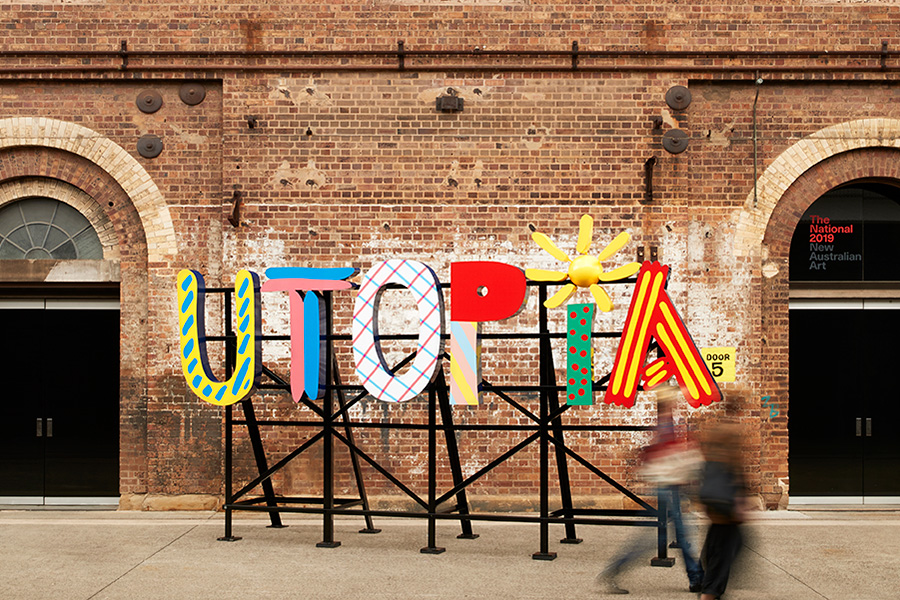
Image: Sam Cranstoun, Utopia, 2019. Installation view, The National 2019, Carriageworks, Sydney. Photograph by Image Zan Wimberley. Courtesy the artist.
SAM CRANSTOUN (QLD)
Sam Cranstoun began his career as an accomplished photorealist painter. More recently, he has supplemented his practice with appropriation and research-based approaches that extend to sculpture, video and installation. These developments are apparent in his works drawing on the life and work of the Greek architect and urban planner Constantinos A. Doxiadis. This project developed from Cranstoun’s discovery that Doxiadis, a key figure in modern Greek architecture, spent time in Brisbane’s suburbia in a kind of incongruous exile during the early 1950s. On either side of this period, he had a glittering international career, most notably in the 1960s as the lead designer of Pakistan’s capital, Islamabad. His Australian hiatus, however, was occupied with tomato farming and family. A drawing of Cranstoun’s, from a group of works in pencil based on Doxiadis’s family photographs, shows the beaming architect showing off his tomato seedlings. These works were included in Cranstoun’s exhibition To Speak of Cities (2021) at the University of Queensland Art Museum, which showcased his work on Doxiadis. Other works from that exhibition include a group of wall-based sculptures made from breeze blocks – a staple of mid-century Australian suburbia – assembled into geometric designs recalling Doxiadis’s town plans. In another piece, Cranstoun took the titles of the architect’s books and essays, and painted boldly-coloured, typographical-design book covers for them. Together, the titles – including ‘Building Our Cosmos’, ‘The Inevitable City of the Future’, and, simply, ‘Utopia’ – give a picture of proselytising, utopian modernism. The other components of the exhibition included a video work, drawn from Cranstoun’s research visits to Athens and Corfu, where he interviewed Doxiadis’s daughter, and elements of classical architecture, which ‘float’ into the gallery space like parts of a stage set. The latter recall classicism’s European incarnations, with which Doxiadis was intimately familiar, along with the ersatz interpretations of the style, which had their efflorescence in Australian suburbia of the 1960s and ’70s. A key piece in Cranstoun’s Doxiadis series is Utopia (2019), a large-scale sculpture of the word itself, each letter given its own colourful, kitschy style. Part of The National 2019: New Australian Art, and installed at the entrance to Carriageworks, Sydney, it emulates the appearance of Ken Done’s famous ‘AUSTRALIA’ sign, made for Brisbane’s 1988 World Expo. Utopia thus brings together Doxiadis and Done in a gesture that critiques the sunny complacency of Australian suburbia – and aptly sums up the contradiction of Doxiadis’s time in our country.
Since his Doxiadis project, Cranstoun has returned to photorealistic painting in a way that again subverts the traditions of modernity. These works take images of sculptures by modern masters, combining them into witty and absurd assemblages that Cranstoun calls “superstructures”. In Superstructure III (2021), a Calder mobile grows from the head of Brancusi’s Sleeping Muse, like a plant from a seed. In Superstructures VI (2022), a Moore, Calder, Duchamp and Brancusi are fused together in a composition that purists might find grotesque, but that others will find a sly and refreshing piece of visual comedy. These paintings can be seen as products of a combinatory logic that takes its cues from various mass-produced visual discourses. Academicism imagined it found excellence in the judicious combination of artistic virtues – the colour of the Venetians, say, combined with the drawing of the Florentines. This derivative visual tactic also appealed to those working in the pre-internet era, when Terry Smith’s “provincialism problem” described much of Australia’s ‘internationalist’ cultural production.[1] A further example is found in the visual products of AI, which meld disparate imagery through an algorithmic logic. Cranstoun takes the combinatory approach underlying these discourses to absurdity through applying them in a straightforward and unembarrassed way to Modernism. The unhinged and strangely beguiling results thus take the combinatory logics of provincialism, academicism and our AI-suffused lives to extremes, and the resultant absurdity functions as a critique of these discourses.
[1] Terry Smith, ‘The Provincialism Problem’, Artforum, vol. 13, no. 1, 1974, pp. 54–59.
Essay written by Michael Newall.
Michael Newall is a writer, academic and Co-Director of The Little Machine: Space for Contemporary Art in Tarntanya/Adelaide, South Australia.
2027 Samstag International Visual Art Scholarship
2010 Bachelor of Fine Arts, Queensland University of Technology
2009 Bachelor of Fine Arts (Visual Arts), Queensland University of Technology